
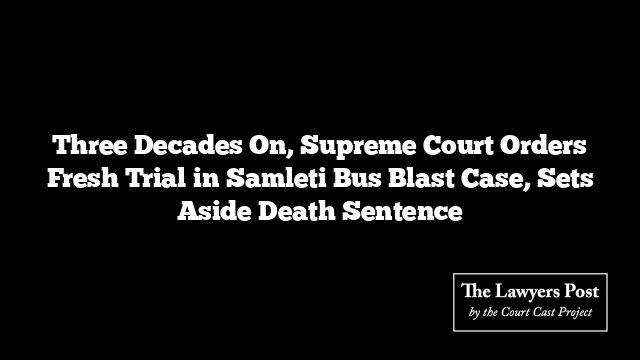
Nearly 30 years after the Samleti bus bombing claimed 14 lives, the Supreme Court has ordered a fresh trial for death row convict Dr Abdul Hameed, holding that the fairness of the original proceedings was undermined by ineffective legal representation.
A bench of Justices Vikram Nath, Sanjay Karol and Sandeep Mehta set aside the Rajasthan High Court’s 2019 judgment insofar as it upheld Hameed’s conviction and death sentence. The Court directed that the case be tried afresh from the stage of recording prosecution evidence.
The fresh proceedings will be conducted by a Special Court in Jaipur. The Rajasthan High Court has been asked to designate a judicial officer of the Rajasthan Higher Judicial Service with at least seven years’ experience in conducting sessions trials. The Supreme Court has also urged the Special Court to complete the de novo trial within one year.
All prosecution witnesses will have to be summoned again, allowing Hameed a full opportunity to cross-examine them.
The Supreme Court made it clear that its findings were limited to the fairness and legality of the earlier trial. The evidence against Hameed must be independently assessed by the Special Court, without being influenced by the observations contained in the judgments that have now been set aside.
The Court also ordered that if Hameed is unable to arrange legal representation of his choice, the Rajasthan State Legal Services Authority must provide him with a lead defence counsel having at least 10 years’ standing at the Bar, assisted by another advocate with a minimum of seven years’ experience.
Hameed will remain in judicial custody during the fresh proceedings. However, he may apply for bail before the Special Court, which will consider the application independently and without being guided by the findings of the earlier judgments.
In the same judgment, the Supreme Court acquitted Pappu alias Salim and rejected the State’s challenge to his permanent parole. It also dismissed the State’s appeals against the acquittal of Javed Khan and Abdul Goni.
The 1996 Blast
The explosion took place on May 22, 1996, when a Rajasthan Roadways bus travelling from Agra to Bikaner was blown up near Samleti village after leaving Mahwa. Fourteen passengers were killed and 37 others were injured.
According to the prosecution case, two men boarded the bus at Agra after purchasing tickets for Jaipur. They allegedly returned the tickets and got off at Mahwa. The prosecution claimed that an explosive device containing around 2.5 kilograms of RDX had been placed beneath seats 17 and 18 and detonated while the bus was moving.
Investigators alleged that the attack was linked to members of the Jammu and Kashmir Islamic Front and Harkat-ul-Ansar and formed part of a wider conspiracy connected to efforts to spread terror ahead of the 1996 elections in Jammu and Kashmir.
Following the filing of multiple supplementary charge sheets, several accused faced trial under provisions of the Indian Penal Code, the Explosive Substances Act and the Prevention of Damage to Public Property Act.
The prosecution alleged that Hameed and Abdullah planted the improvised explosive device beneath the bus seats before getting off at Mahwa. Other accused were alleged to have played different roles in the broader conspiracy, including arranging logistics, procuring explosives, facilitating the movement of operatives and providing other assistance.
The trial court convicted Hameed and six others in 2014. Hameed was sentenced to death for murder, along with additional sentences under other laws, while the other convicted accused were sentenced to life imprisonment.
The Rajasthan High Court later upheld Hameed’s conviction and death sentence. The Supreme Court has now set aside that decision in relation to Hameed and ordered that the case begin afresh, leaving the question of his guilt to be decided independently on the evidence presented in the new trial.