
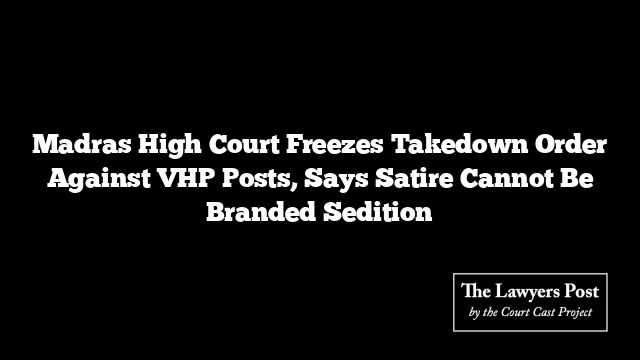
The Madras High Court has put the brakes on a Tamil Nadu Police directive that sought the removal of several posts uploaded on X by members linked to the Vishwa Hindu Parishad, delivering a sharp reminder that constitutional democracy survives on criticism, not silence.
Hearing a challenge to the May 8 blocking notice, a Division Bench comprising Justice L Victoria Gowri and Justice N Senthilkumar observed that the State cannot blur the line between dissent and disorder.
“A democracy cannot treat criticism as disorder, satire as sedition, dissent as danger or opinion as offence,” the Bench remarked while granting interim relief.
The case arose from a petition filed by P. Chockalingam, head of the North Tamil Nadu unit of the VHP, questioning a notice issued by the Cyber Crime Wing under Section 79(3)(b) of the Information Technology Act and the 2021 Intermediary Rules. The notice directed X to block multiple URLs within three hours.
The Court found the order troubling at first glance. According to the Bench, the notice failed to provide post-specific reasoning, bundled together content from different users under a single direction, and appeared to bypass constitutional safeguards laid down by the Supreme Court in Shreya Singhal v. Union of India.
In a strongly worded order, the Bench said the problem with blanket censorship lies not merely in its breadth but in its opacity.
“When the State restricts speech, it must speak through reasons,” the Court noted, adding that constitutional liberties cannot be curtailed through vague or mechanical commands. Political opinions, it stressed, do not lose protection merely because they are uncomfortable, sarcastic, inconvenient or sharply critical.
The judges underscored that Article 19(1)(a) safeguards more than agreeable speech.
“It protects criticism, dissent, satire, political disagreement and robust public debate,” the Bench said, adding that free speech faces its real test when the views expressed are unpopular with those in authority.
Drawing from the Supreme Court’s reasoning in Shreya Singhal, the Court reiterated the distinction between discussion, advocacy and incitement. Discussion and advocacy — even of disagreeable ideas — remain constitutionally protected unless they cross into incitement.
The Bench also cautioned against the “chilling effect” caused by vague online censorship orders. Such actions, it said, silently pressure citizens into self-censorship because the boundaries of permissible speech become uncertain and unpredictable.
Another aspect that drew judicial criticism was the extraordinary three-hour compliance window imposed on X. The Court observed that no material had been presented to show any immediate threat or emergency justifying such urgency.
Although the State defended the notice on grounds of maintaining public order, the Bench pointed out that no detailed affidavit had been filed explaining the allegedly offending content or the legal basis for the emergency takedown.
The High Court has now stayed the blocking notice and directed authorities to inform X Corp to restore the affected URLs.
At the same time, the Court clarified that the government remains free to initiate action against specific posts in future — provided it satisfies the limits imposed under Article 19(2), records clear reasons, and follows due procedure under the IT framework.
The matter is scheduled for further hearing on June 8. Before then, the State has been asked to place on record the exact reasons behind the blocking order, the statutory basis invoked, the justification for the three-hour deadline, and whether the affected users were granted an opportunity to respond before the takedown direction was issued.