
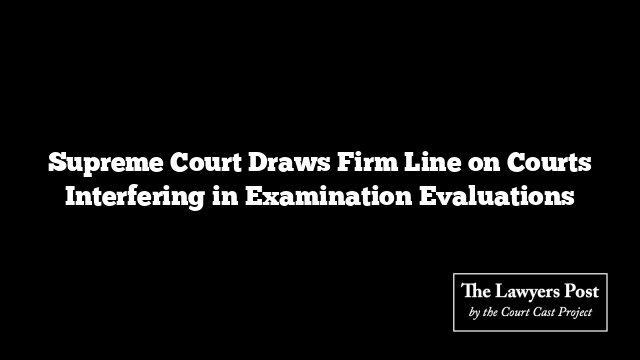
The Supreme Court has cautioned High Courts against stepping into the domain of academic experts while exercising judicial review over examination-related disputes.
A bench comprising Justice Dipankar Datta and Justice Sheel Nagu set aside an order of the Allahabad High Court that had intervened in the Uttar Pradesh Public Service Commission’s handling of disputed examination questions and answer scripts.
The High Court had issued directions concerning re-evaluation of answer sheets, deletion of certain questions and the grant of full marks for some questions.
The Supreme Court found such intervention contrary to the settled principles governing judicial review in academic matters, particularly those laid down in Ran Vijay Singh v. State of Uttar Pradesh.
The bench observed that the High Court had gone beyond the permissible limits of judicial review by examining disputed questions from different academic subjects as though it were itself an authority of academic experts.
The Court stressed that judges do not possess the specialised expertise required to assess the correctness of examination questions or answer keys. Such matters ordinarily fall within the domain of academic authorities.
The Supreme Court reiterated the principles governing judicial intervention in examination disputes:
- Re-evaluation or scrutiny can be permitted where the applicable statute, rule or regulation expressly provides for it.
- Where the governing rules neither permit nor prohibit re-evaluation, courts should allow it only in rare and exceptional circumstances where a clear and demonstrable error is established, without relying on inference or extensive reasoning.
- Courts should not themselves re-evaluate or scrutinise answer sheets because academic assessment is best left to those with the necessary expertise.
- Examination authorities’ answer keys should ordinarily be presumed to be correct.
- Where genuine doubt remains, the benefit should ordinarily go to the examination authority rather than the candidate.
The Court noted that the Allahabad High Court had undertaken an extensive assessment of questions belonging to different academic disciplines and, in doing so, effectively replaced the conclusions of the subject experts with its own views.
Judicial review, the Supreme Court clarified, is concerned with the legality and fairness of the decision-making process. It does not permit a court to assume the role of an academic evaluator or substitute its own assessment for that of qualified experts.
Finding the High Court’s directions unsustainable, the Supreme Court allowed the appeal filed by the Uttar Pradesh Public Service Commission.